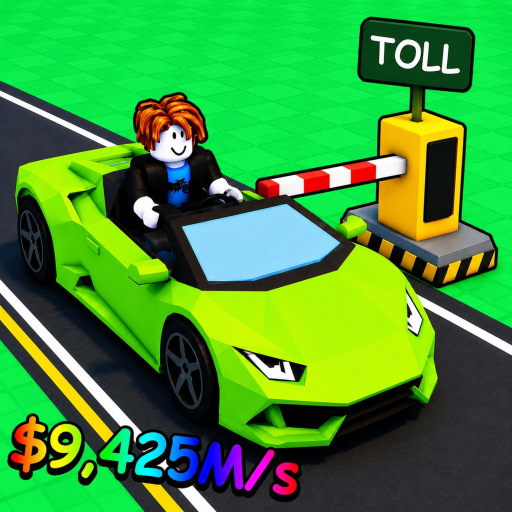
Roll the Car RNG lever
Cars come from the Car RNG lever next to the conveyor belt. Each pull rolls the game's RNG and lands you one car from the rarity pool.
My Toll Farm! has no combat units or character classes — its entities are cars, and its builds are income lineups. This is the reference for both, with every table sourced and dated.
Every entity in My Toll Farm! is a car won from the Car RNG lever beside the conveyor belt, and every build is the same economic machine: place cars on belts so they pay toll tax per pass, then raise that payout with the four documented levers — rarer cars, more lanes, Toll Level upgrades, and rebirths — plus Roll Luck mutations (Bronze, Silver, Gold, Diamond, Void) that boost an individual car's earning stats. The documented roster is 25 cars across seven rarities from Common to Exclusive, tabled below with its source and checked date.
Source: Sportskeeda cars reference, published August 20, 2026; checked 2026-10-03.
| Rarity tier | Cars | Count |
|---|---|---|
| Common The seven starter bodies — the first belts fill up with these. | Panda, Berlingo, Tinbox Alpha, Family Van, Reliable Beige Sedan, Pocket Crossover, Cozy Rover | 7 |
| Uncommon | Mehari, Trail Scout, Royal Yellow Cab, Workhorse Pickup | 4 |
| Rare | Secret Agent SUV, Mail Truck, Brickhouse 4x4, Cosmic Cruiser '70, Highway Stinger | 5 |
| Epic | Wild Stallion '65, Muscle Menace, Silent Spark Y, Venom Strike | 4 |
| Legendary | Streetzilla 35, Midnight Arrow 8, Raging Tempest | 3 |
| Mythic The single Mythic of the documented roster. | Royale Velocity | 1 |
| Exclusive Outside the seven normal tiers; the cars reference lists no public obtainment rate for it. | Dune Bug Bean | 1 |
The roster was documented on August 20, 2026 — before the Collector's UPDATE window advertised NEW EXCLUSIVE CARS — so treat the count as a floor and re-check the in-game cars index. No official price list, per-car income table, or pull-rate table exists for any tier.
Documented by the publisher cars reference and visible in any first session.
Cars come from the Car RNG lever next to the conveyor belt. Each pull rolls the game's RNG and lands you one car from the rarity pool.
Every car you own can be placed on a conveyor belt. From that moment it pays toll tax each time it passes your toll booth.
Income is incremental: cars keep looping past the booth and paying out while you watch, upgrade, or leave the game running.
Spend what the booth collects on rarer cars, extra conveyor lanes, Toll Level upgrades, rebirths, and Roll Luck — the documented income multipliers.
Mutation ladder: Bronze → Silver → Gold → Diamond → Void. Reported codes add Luck Rolls (x5, x10, and a tracker-worded 99x) that feed the same pull window — see the codes page.
A build here is an economy, and these are its only documented dials.
The cars reference is explicit that rarer pulls raise your farm's basic income: a Legendary body out-earns a Common one doing the same laps.
Unlocking extra conveyor lanes adds whole rows of car slots. More cars on belts at once means more toll events per minute, and lanes keep paying even with a modest roster.
Upgrading the toll level raises what every pass-through pays, so it multiplies the cars you already own instead of replacing them.
Rebirthing resets progress in exchange for a lasting income raise — the classic incremental tradeoff, documented as one of the four ways to increase your farm's basic income.
Upgrading Roll Luck lets pulls land with a mutation — Bronze, Silver, Gold, Diamond, or Void — each boosting that vehicle's basic money-earning stats.
Said once, here, so the tables above stay clean.
JOFO Games has never released car prices, per-car income, pull rates, mutation odds, or a Toll Level cost curve. Any site printing those figures is estimating — this one measures instead (see the resource calculator).
The 25-car table reflects August 20, 2026 documentation. Weekly update windows keep adding cars — the live in-game cars index is always the final word on what exists today.
Because no income table exists, a S-through-F ranking would be invented. The tier list holds that line and ranks what the evidence does support.
The documented roster holds 25 cars across seven rarity tiers — Common (7), Uncommon (4), Rare (5), Epic (4), Legendary (3), Mythic (1: Royale Velocity), and Exclusive (1: Dune Bug Bean) — per the Sportskeeda cars reference published August 20, 2026. Update windows can add more; the Collector's UPDATE window advertised NEW EXCLUSIVE CARS.
Pull the Car RNG lever next to the conveyor belt. Each pull rolls the game's RNG and lands one car from the rarity pool; every car you win can be placed on a belt to start earning toll tax.
Mutations are earning multipliers on an individual car. Upgrading Roll Luck lets a pull land with Bronze, Silver, Gold, Diamond, or Void — each boosting that vehicle's basic money-earning stats, per the documented mutation ladder.
Common, Uncommon, Rare, Epic, Legendary, Mythic, and Exclusive — seven tiers, with Common the easiest to pull and Mythic/Exclusive the hardest. The published roster names exactly one Mythic and one Exclusive.
No source publishes per-car income, so a number would be a guess. The documented rule is directional: rarity raises basic income, and mutations multiply it — so the practical answer is the highest-rarity, highest-mutation car your belts hold.
My Toll Farm!'s developer has never released an official stat table, code list, or patch notes. This site therefore documents community knowledge with the source and checked date attached to every table, and we mark anything a publisher has not confirmed as community-documented. When two trackers word the same code differently (as they do for the luck-roll codes), both readings are shown instead of averaged.
Choose the adjacent page that matches the next player question.